Serving All of Northern Jersey
License Number 16590



Standby Generator Installation in Bergen County, NJ: Licensed Electricians
licensed, insured, and bonded, working out of our own shop in Bergenfield, inside the county, with head electrician Robert “Bobby” Mulholland, who has more than 30 years of field experience..
A typical installed price runs $12,000 to $20,000, depending on the size of the house. Our standard scope covers permits, town approval, a concrete pad, a fuel line, a transfer switch, and a simulated outage test before we hand it over.
Call +1 201-385-5000 for a free on-site estimate.

Standby Generator Installation Costs and Company Details
| Installed cost | $12,000 to $20,000, sized to the house |
| Most common size | 16 to 22 kW |
| Who does the work | Licensed electricians, in-house crews |
| Credentials | Licensed, insured, and bonded. NJ License #16590 |
| Rating | 4.9 stars across more than 400 verified reviews |
| Warranty | 1 year on parts and labor |
| Based in | Bergenfield, NJ |
| Estimate | Free, on-site |
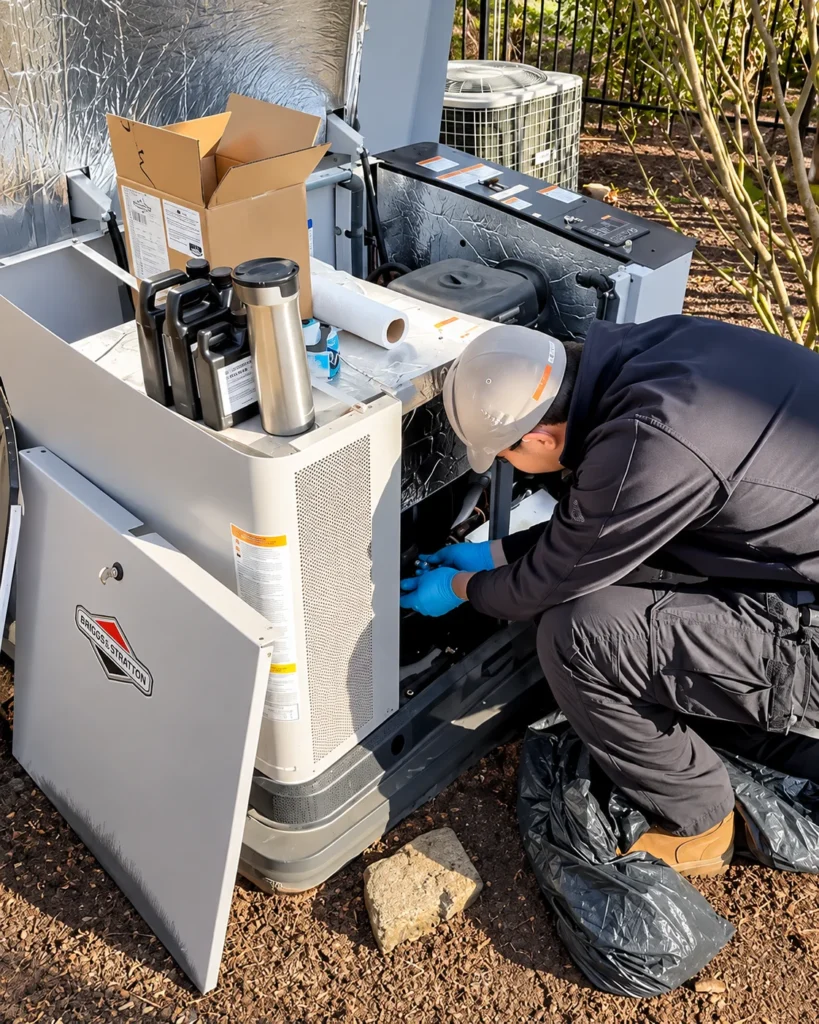
Standby Generator Installation in Bergen County, NJ: Who Does the Work
A standby generator is not a swap-in job. It ties into your gas line, your main panel, and a transfer switch that has to pass municipal inspection, which is one of several reasons to hire an electrician rather than a handyperson for this work. In New Jersey that is one construction permit covering both trades, and the electrical side has to be pulled by a licensed electrical contractor.
Bergen County’s own guidance says the same: a home generator should be installed by a licensed electrical contractor, and the installation requires an electrical permit and an electrical inspection. We are an electrical contractor first. Generators are one of the things we install, which is why the panel, the grounding, and the load calculation stay with the same crew.
Robert “Bobby” Mulholland, our head electrician, has more than 30 years on the tools. Barret Abramow, co-owner and project manager, runs the first site visit himself and sizes the system against your actual load. Grounded Electric is a Generac dealer.
The same two people handle every generator job here. The one who quotes it manages it, and the one who wires it holds the license. We hold New Jersey electrical contractor License #16590, which you can verify with the NJ Division of Consumer Affairs.
+500
Services
In North Jersey Area
Whole House or
Partial Home Backup
Automatic Backup Power and Setup Options
An automatic standby unit sits outside on a pad, watches the utility feed, and starts on its own within seconds of an outage. If you are weighing it against other forms of backup power for New Jersey homes, that automatic start is the main difference. No cords, no manual switching, nothing to carry out of the garage in the rain.
Older homes across the county often need panel work alongside the backup unit.
Your choice comes down to three things: how much of the house you want running, which fuel you have at the curb, and where the unit can legally sit on your lot, which the permits section below covers in detail.
Whole House or Essentials Only
A whole house generator carries your full load, including central air. A partial system keeps the lights, refrigerator, outlets, heat, and well pump running, while leaving the rest dark.
We run a site check before recommending either. That covers available gas pressure or propane capacity, panel condition, setback distances, and compliance with New Jersey’s electrical subcode. Both natural gas and propane work, and propane needs tank capacity sized to your expected runtime.
Most Bergen County homes that want lights, a refrigerator, outlets, and a 3-ton central air unit covered end up at 16 to 22 kW. Larger homes with multiple cooling zones go higher, up to 28 kW.
Our What Size Generator Do I Need? guide walks through the math, the generator size chart gives a starting point ahead of the site visit, and if you are on a 200-amp panel, what a 200-amp service supports answers the question most homeowners hit next.
What Standby Generator Installation
NJ Costs in Bergen County
Expect $12,000 to $20,000 installed for a residential standby system, sized to the house. That figure covers the unit, the pad, the fuel line, the transfer switch, permits, and startup testing. It is not equipment-only pricing.
| What you want powered | Suggested size | Where it falls in the range |
|---|---|---|
| Essential circuits only: lights, refrigerator, outlets, heat, well pump | 10 to 14 kW | Lower end |
| Most common: lights, refrigerator, outlets plus one 3-ton central air unit | 16 to 22 kW | Middle |
| Larger home, multiple cooling zones, full-house coverage | 24 to 28 kW | Upper end |
If you are holding a quote and trying to judge it, check what the number includes rather than the number itself. A complete quote covers the unit, the concrete pad, the fuel line run and pressure test, the transfer switch, the permit fee, and a live outage test.
A quote well below that range usually leaves something out. The pad, the permit, and the gas line are the three most often missing, and each one lands back on you later. Ask which of those six items a quote covers before comparing it with ours.
We quote per property rather than off a price list, because site prep varies more than the hardware does. A pad on flat ground beside an existing meter is a different job from trenching forty feet of gas line around a pool.
4.9
(400+ Ratings & Reviews)


What Moves the Price Up or Down
Three variables do most of the work:
- System size. Capacity drives hardware cost directly. Going from 16 kW to 28 kW is the single biggest line-item jump.
- Site prep and permits. Pad construction, trenching distance, panel condition, and municipal permit fees, which differ town to town across the county.
- Fuel choice. Natural gas needs a tap and adequate pressure. Propane needs a tank, and tank size scales with how long you want to run.
Panel condition is the one that surprises people. If your existing service cannot handle the transfer switch, that upgrade gets quoted separately and has to happen first, and knowing how much it costs to replace an electrical panel gives you the range before we arrive.
Installed price is one number and running cost is another. Cost to operate a Generac generator covers what it costs to run during an outage.
Recent Bergen County Installs
Every install is a different lot, a different panel, and a different run to the meter. Here is recent work across the county.
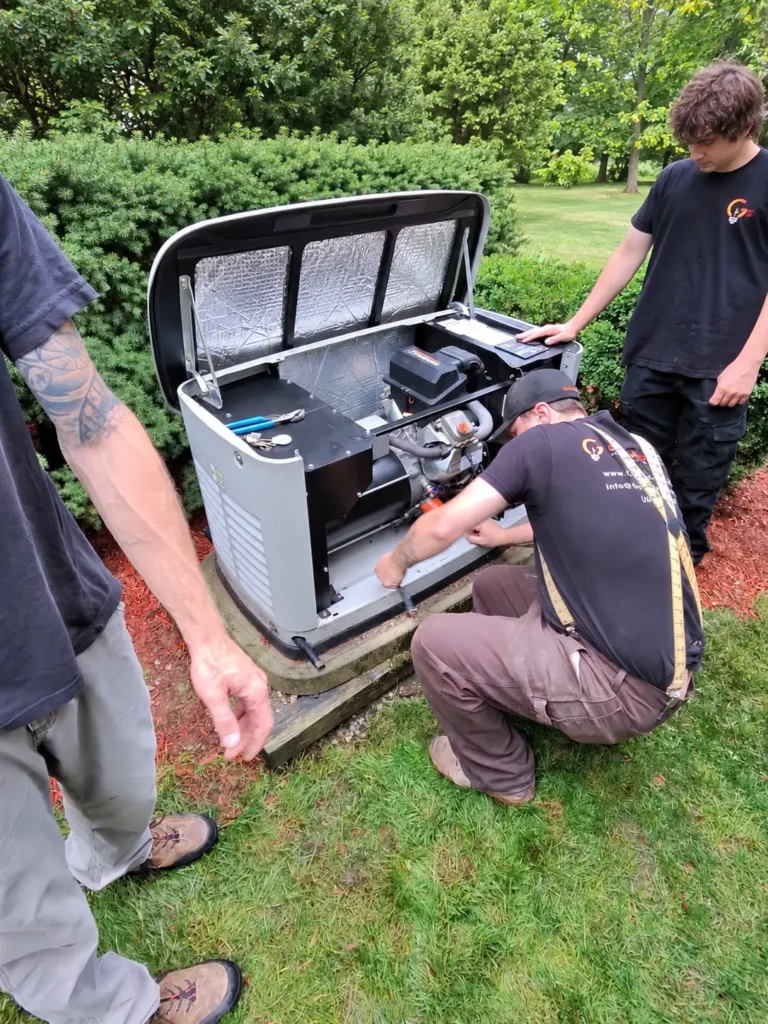
Demarest, 22 kW natural gas
A home standby generator installation in Demarest, run through the same process as every job on this page: permit filed with the township, pad set, fuel line run and pressure-tested, transfer switch wired into the panel, and a live outage test before handover.
Inside a Standby Generator Install
In this video, you can see a lamp and lighting elements that we have installed for our clients.

The Generac Installation
Process: Step by Step
Consultation, Site Assessment, and Quote
Barret visits, reviews your energy use, and walks the property to find a legal, serviceable spot for the unit. He checks panel capacity, fuel availability, and setback distances at the same time.
You get a written quote from that visit. The estimate is free and on-site. We file permits with your municipality once you approve.
If the unit runs on natural gas, a second application runs alongside the permit. PSE&G’s residential gas service application asks for equipment spec sheets showing the unit’s pressure and BTU load, and PSE&G states that gas generator projects can take up to six weeks. That step, rather than the town permit, is usually what sets your start date.
What Happens On Site
- Concrete pad. Pour or set the base the unit sits on.
- Fuel lines. Run and pressure-test the natural gas or propane supply.
- Transfer switch. Install and wire the switch that moves your home off utility power.
- Outage simulation test. Cut utility feed and confirm the unit starts, carries load, and hands back cleanly.
We do not call the job finished until the system has run your house with the utility off. Electrical contractors and generator crews who skip the live test hand over systems that nobody has proven.
Fuel Line Work, Electrical Setup, and Testing
Fuel work and electrical work happen under the same permit and must satisfy the New Jersey Uniform Construction Code electrical subcode, and the manufacturer’s own Generac installation guidelines set the clearances and siting rules on top of that. Standby systems like these fall under the National Electrical Code’s optional standby provisions, which govern transfer switch wiring and grounding.
We wire the transfer switch into your main panel, handle code-compliant ground wire installation, and verify every circuit you paid to have backed up is on the backed-up side. Mislabeled circuits are a common defect, so we check each one before handover.
Testing covers startup time, load transfer, retransfer, and the weekly self-test schedule. Fuel side varies by property: some jobs need us to add a natural gas line for the generator, others need propane gas line installation, and a few need a gas meter upgrade first.
Final Inspection and Customer Handover
The municipal inspector signs off, then we walk you through the unit: the self-test light, the control panel, what each alarm code means, and when to call.
You leave that walkthrough knowing how to tell whether your system is healthy without opening anything.
Working Across the County from Bergenfield
Our shop is in Bergenfield, inside Bergen County rather than outside it. We cover the county from there, and our service areas page lists every town by name. The ones we work in most often:
Coverage runs to the county line in every direction, not only the towns nearest the shop.
Bergen County is served by three electric utilities, PSE&G, Orange and Rockland, and JCP&L, with Orange and Rockland covering much of the northwest. Which one serves your address affects how long you are likely to be out, and that gap is what a standby unit exists to cover.
During Tropical Storm Isaias in August 2020, more than 100,000 Bergen County customers lost power, the largest count of any county in New Jersey, and some towns waited five days for restoration.
Hours, Response, and Emergency Work
The office is open Monday to Friday, 8 AM to 4 PM. During business hours we typically respond within the hour.
We do not have someone permanently on call. We take emergency work when a technician is available, starting at $350 an hour.
That is worth knowing before a storm rather than during one. If you want a system in place for the season, work back from the six-week PSE&G gas application rather than from the forecast.

Licenses, Team, and Reviews

Robert "Bobby" Mulholland
Head Electrician
Our head electrician and license holder Robert “Bobby” Mulholland has
over 30 years in the field. He is our fearless, tackle any project, can do it all
Electrician/ Co-owner.

Barret Abramow
Electrician
Barret our Project manager and co-owner is a skilled electrician with a strong foundation in both hands-on electrical work and business operations. A graduate of Hofstra University with a degree in Management, he combines technical expertise with a sharp understanding of project planning, customer service, and efficient business practices.
As co-owner of Grounded Electric, Barret is dedicated to delivering high-quality electrical solutions while ensuring the company operates with integrity, professionalism, and a customer-first mindset.

Ryan Abramow
Director of Operations
What our Customers have to say

Jonathan King


Grounded Electric just installed a generator switch for us today. When we called, they came out quickly and we received a detailed written estimate shortly after that, and scheduling was equally efficient. They arrived when they said they would. The crew took care to minimize the holes they had to cut and fastened the plasterboard back in place. Before they left they explained how to use the switch and cleaned up so well, it looked like they had never been here. We are extremely pleased and will definitely use them again. Positive Responsiveness, Punctuality, Quality, Professionalism, Value Services Service not listed

Claire Ellen Ginsburg
It has been a pleasure to do business with them. I went back to hire them to do another job for us after they had installed the cap on our electrical outside wires . They will be rehired to install the generator switch on the boiler. Claire and Larry Goldstein Positive Responsiveness, Punctuality, Quality, Professionalism, Value Services Electrical socket and switch repair

Blake Baron
If looking for an electrician, Grounded Electric is my go-to. Bobby and Barrett are extremely knowledgeable, dependable and get the job done as quoted. I have had them over for numerous jobs and I am always very impressed with their work product and turnaround time. These guys are the best! Positive Responsiveness, Punctuality, Quality, Value
After-Installation Care
and Support Services

A standby generator needs a professional visit on a schedule to stay reliable, and most owners put it on a plan so it gets calendared rather than remembered. A full visit covers both halves of the system, the engine side with oil, filters, and battery, and the electrical side with the transfer switch and a load test under real household demand.
Our Bergen County generator maintenance page covers what each visit includes, the manufacturer’s intervals, and what it costs.
Repairs and Warranty Coverage
Once your system is in, we stay on it. Scheduled upkeep and repairs go through us rather than a call center.
Two warranties apply after an install and they cover different things. The unit carries Generac’s manufacturer warranty. The installation carries ours, one year on parts and labor. If something fails, we will tell you whether the claim goes through Generac or through us. We also handle generator repairs on any brand, in or out of warranty, including units another company installed.
Register the equipment with Generac once the inspection signs off. That registration doubles as proof of purchase for an insurance claim involving fire, flood, or theft, which is the detail most owners miss.
Standby Generator Installation in Bergen County: Common Questions
How much does standby generator installation cost in Bergen County, NJ?
How much does standby generator installation cost in Bergen County, NJ?
A residential standby system runs $12,000 to $20,000 installed, sized to the house, including equipment and permits. Essentials-only builds sit at the lower end and homes with several cooling zones at the upper end. Every job gets a figure after the site visit.
What size standby unit does my Bergen County home need?
What size standby unit does my Bergen County home need?
Most homes land in that same range. Larger homes with multiple cooling zones go to 28 kW. Startup draw, not nameplate wattage, sets the size, which is why we assess on site.
Do I need a permit to install a standby generator in New Jersey?
Do I need a permit to install a standby generator in New Jersey?
Yes. It takes one Uniform Construction Code permit with an electrical subcode section for the transfer switch and panel connection, and a mechanical subcode section for the gas line. Propane units add a fire protection subcode review.
You file with your own municipality, since New Jersey has no county or state permit office, and the town has 20 business days to issue or deny a complete application. We file it, schedule the inspection, and attend it.
How long does installation take?
How long does installation take?
Two clocks run, and the gas one is longer. Your municipality has 20 business days to issue or deny a complete electrical permit. If the unit runs on natural gas, PSE&G’s residential gas service application can take up to six weeks, and that is usually what sets your start date rather than the permit.
The cost to service a Generac generator typically ranges from $200 to $500 per visit.
This price usually includes:
Testing the automatic transfer switch
Checking and tightening electrical connections
Inspecting fuel lines for leaks or blockages
Replacing air and oil filters
Changing engine oil and fluids
Running diagnostic tests
Annual maintenance plans may cost between $300 and $600 per year, depending on your location, generator size, and whether emergency service is included.
For larger standby units or commercial models, the cost may be higher. Always confirm with a certified Generac technician for exact pricing in your area.
Natural gas or propane: which is better?
Natural gas or propane: which is better?
Natural gas if you have a tap with adequate pressure, since you never refuel. Propane if you do not, with tank size scaled to the runtime you want. We check available gas pressure during the site visit before recommending either.
Where can the unit sit on my property?
Where can the unit sit on my property?
Not anywhere. It cannot go under a deck or within 5 feet of a window, door, or air intake, and it has to meet the side and rear yard setbacks for your zoning district, which each town sets for itself. Front yards are generally not permitted. Manufacturer clearances apply on top of that, and the greater distance governs.
Do permit fees differ between Bergen County towns?
Do permit fees differ between Bergen County towns?
Yes, because each municipality sets its own schedule. Hillsdale charges generators on the electrical subcode by size, $65 for 1 to 10 kW, $100 for 11 to 20 kW, and $150 for 21 to 50 kW, plus a separate $75 mechanical subcode fee. Saddle Brook prices the same work differently. We quote permits per property.
Which utility serves my address, and does it matter?
Which utility serves my address, and does it matter?
Bergen County is served by three: PSE&G, Orange and Rockland, and JCP&L, with Orange and Rockland covering much of the northwest. Which one covers you affects how long an outage lasts, and that gap is what a standby unit exists to cover.
How long do Bergen County outages actually last?
How long do Bergen County outages actually last?
Most are short. The ones that matter are not. During Tropical Storm Isaias in August 2020, more than 100,000 Bergen County customers lost power, the largest count of any county in New Jersey, and some towns waited five days for restoration.
Why did my standby unit shut itself down mid-outage?
Why did my standby unit shut itself down mid-outage?
Usually restricted airflow. Leaves, snow, or stored items inside the two-foot clearance zone trigger a self-protective shutdown. Low oil and overload are the other common causes, and the fault code tells us which before anyone opens a panel. If yours will not start, runs for 30 seconds then stops, or shows another common generator problem, those pages cover the diagnosis.
Do you service units you did not install?
Do you service units you did not install?
Yes. We take on maintenance, repairs, and warranty work on existing systems across Bergen County, including units installed by other contractors.
Meet the Rest of the Grounded Electric Team
Each job is handled by a coordinated crew that plans, installs, and finishes as one unit. Roles are clear, communication stays tight, and every step follows the same safety and quality standards. You work with familiar faces who know your project from start to finish.

Residential Electrical Repairs and Upgrades in Bergen County
We are electricians first, which means residential electrical repairs Bergen NJ homeowners need are already in our wheelhouse: dead circuits, failing outlets, flickering lights, breakers that will not hold, and aging knob-and-tube still found in older Bergen County homes.
Residential electrical upgrades Bergen NJ properties commonly need: electrical panel upgrades, added circuits for additions, and service capacity increases. An electrical inspection tells you which of those you actually need.
We also handle EV charger installation and can walk you through New Jersey EV rebates. For connected systems, see smart home installation and lighting.

Call any time