



Artificial Intelligence in smart devices means connected products use software to read inputs, spot patterns, and respond with better actions over time. In smart homes, this can include voice control, security alerts, lighting schedules, and load management based on sensor activity and user habits.
Grounded Electric works with home electrical systems that support automation, device setup, and load planning. This topic has clear value for installations. In practice, artificial intelligence (AI) helps devices make faster, more useful decisions.
Key Takeaways
Artificial intelligence in smart devices helps connected products interpret inputs, recognize patterns, and take more useful actions, such as adjusting lighting, climate, or security settings based on real-world conditions.
In smart homes, AI works with connected hardware and sensor data to support automation, but performance still depends on sound electrical planning, device compatibility, and stable network coverage.
Common examples include smart cameras, thermostats, lighting controls, and voice assistants that can reduce false alerts, improve comfort, and support more efficient daily operation.
AI can improve convenience, energy use, and monitoring, but it does not replace proper installation, testing, privacy review, or professional evaluation when electrical work is involved.
The best smart home setup starts with one clear goal, then expands based on power needs, placement, future growth, and how well the devices work together.
How AI Is Used in Smart Devices?
AI is used in smart devices to read information, recognize patterns, and make automatic decisions based on what is happening in the moment. In practical terms, that means a camera can detect unusual motion, a thermostat can adjust to room use, and a voice assistant can respond to spoken commands with more accuracy.
To do this, smart home devices use AI algorithms and models. They also use sensor data and analysis to choose the next step. This is how AI enables faster, more useful responses rather than simple, fixed commands.
How AI Learns User Behavior?
Most systems compare past activity, current inputs, and preset rules. That is why artificial intelligence at home often becomes more accurate after repeated use. This learning depends on collecting data over time, including occupancy, lighting patterns, and HVAC demand.
How AI Automates Daily Tasks?
AI models add context to automation. Instead of relying solely on timers, smart home devices can respond to daylight, schedule changes, weather, or room use. Edge computing can also help by processing some events locally, which may reduce delay and improve privacy.
Artificial Intelligence in Smart Home Systems
A full smart home ecosystem links sensors, switches, cameras, apps, and connected devices so they respond as a single system. That is where AI technology in smart home devices moves beyond isolated gadgets.
Robert “Bobby” Mulholland, a licensed electrician, would view this through the lens of power quality, safe wiring, device placement, and code-aware integration.

What makes a Home Smart?
A home becomes smart when devices communicate, automate, and react to conditions with limited manual input. The Internet of Things and Artificial Intelligence connect physical devices to software logic and response planning. A good system should still stay simple to control and easy to override.
AI Smart Home Devices
Common examples of AI technology include smart thermostats, voice assistants, cameras, doorbells, occupancy sensors, and lighting controls, and browsing a list of top home automation devices can help buyers compare options across categories.
These devices help with comfort, safety, and scheduling in real-world use. Buyers should focus on what the device actually measures, learns, and changes.
How AI and IoT Work Together?
AI and IoT work together because IoT provides the connected hardware, and AI provides the decision layer. This is why these applications often focus on timing, prediction, and response quality.
Barret Abramow, Project Manager and Co-Owner of Grounded Electric, explains that more connected devices increase planning needs. He adds that integrating AI should include network, compatibility, and scope reviews.
Artificial Intelligence in Smart Devices: Examples
Smart cameras: They can reduce false alerts by distinguishing between people, pets, and normal motion.
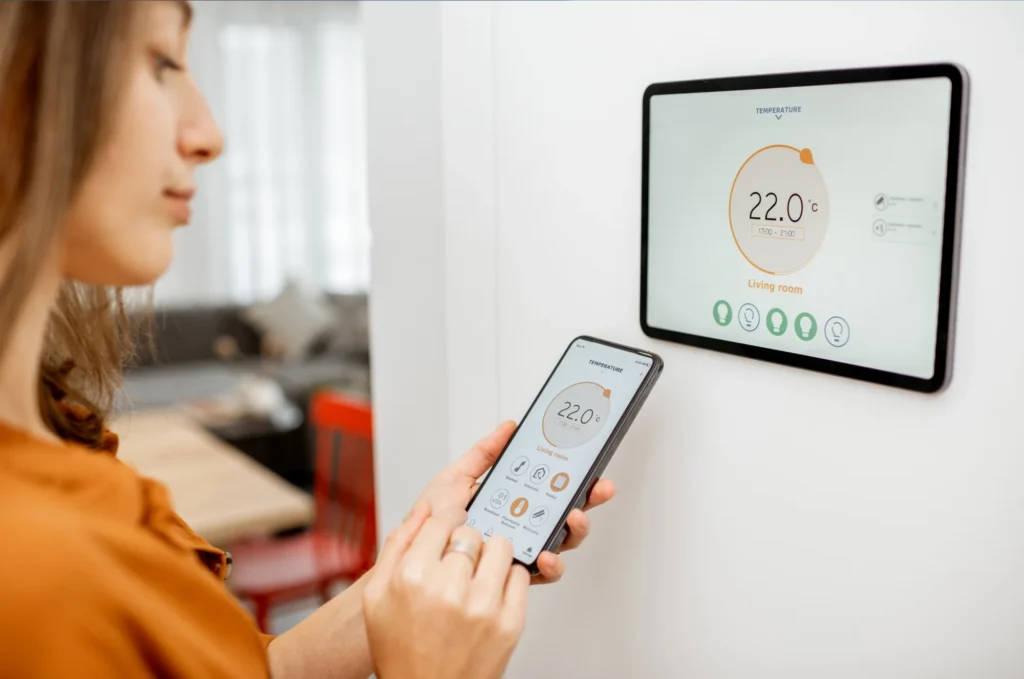
Smart thermostats: They can change heating or cooling based on room use, weather, and daily habits, and pairing them with premium climate controllers can extend that control to multiple zones. This helps support energy-efficient performance.
Smart lighting: These systems can lower energy consumption by reacting to occupancy, daylight, and schedules.
Voice assistants, often built into smart speakers, can combine speech recognition with device control. They can turn on scenes, change temperatures, or manage other smart home devices.
Connected routines: In smart homes, AI in devices can link actions together. It can lock doors, dim lights, and adjust climate settings at once.
Smart Security and Cameras
Security devices often show AI most clearly. Cameras, doorbells, and sensors use image analysis and filtering to decide which events matter more, though results still depend on where security cameras are placed around the property.
Users should still review what data is collected, where it is stored, and who can access it.
How Smart Devices Modify Daily Routines?
Smart devices modify daily routines by adjusting lights, temperature, security, and alerts based on time, occupancy, and user habits. For example, they can turn on lights in the morning, lower the thermostat when the home is empty, lock doors at night, or send alerts when unusual activity happens.
In some systems, generative AI can also help create smarter routines by suggesting schedules, scenes, or commands based on past behavior, a core part of smart home automation. This helps smart homes to reduce manual steps and make daily tasks more consistent. The value comes from supporting real habits simply, not from adding extra actions.
Benefits of Artificial Intelligence at Home
The main advantages of a smart home come down to better control, faster response, and more targeted automation. AI can help manage loads, improve efficiency, and support predictive maintenance by flagging unusual behavior or repeated faults. That does not replace professional inspection, but it can help users notice changes earlier.
Better Convenience and Control
A good setup reduces steps and confusion. Users can manage scenes, alerts, and schedules across the smart home ecosystem with clearer control. Simple functions usually provide more value than extra features.
Energy Savings and Efficiency
AI can lower waste by adjusting runtime, setpoints, and lighting levels to actual conditions, and homeowners often ask whether a smart thermostat actually saves money once those adjustments run automatically.
This can improve efficiency and support more energy-efficient operation over time, especially when paired with a home energy monitor that tracks usage in real time. Results still depend on insulation, equipment condition, and proper electrical design.
Safer Home Monitoring
Better alerts can help users notice access events, smoke alarms, or unusual activity sooner, which is part of why so many homeowners weigh whether home security systems are worth it before investing. Monitoring still depends on correct placement, testing, and secure setup. AI supports safety, but it does not replace sound installation practices.
Risks and Challenges to Know
The main risks are privacy, compatibility, and overreliance on automation. Smart devices depend on software support, network security, and clear settings. Poor Wi-Fi, wrong device selection, or outdated electrical infrastructure can limit performance.
Privacy and Data Security
Users should review permissions, storage terms, update policies, and local processing options. Strong passwords and secure networks are still basic requirements. Privacy review should happen before installation, not after.
Compatibility and Integration Issues
Not all platforms or brands work well together. One app may limit another device, and one protocol may reduce key features in a mixed system. Compatibility should be checked early.
Cost and Setup Complexity
The costs depend on the number of devices, wiring, coverage, and whether the home already supports the planned system, and this guide on smart home cost explains the main factors in more detail. A simple retrofit is not the same as a fully connected design. Projects involving panels, hardwired controls, or integrated equipment may need licensed evaluation.
How to Choose the Right Setup?
Start with one goal, such as lighting control, energy tracking, climate management, or security. Then review power needs, placement, network coverage, and future expansion. A clear scope keeps the system safe, practical, and easier to maintain. In this sense, by choosing the right configuration, you will ensure proper home automation.
