



Most homes need between 3,500 and 10,000 watts to cover essential circuits during an outage, depending on which items are included, and 17,000 to 22,000 watts to run everything at once.
These figures reflect average generator power requirements for typical single-family homes; your total will depend on which circuits you choose to back up. The table below lists the continuous draw and startup surge for 61 common appliances and tools so you can add up your own total.
Every device pulls two different numbers. The steady figure is what it uses minute to minute. The surge figure is the brief spike when a motor or compressor kicks on, and it is often two to three times higher than the rated current.
Grounded Electric helps homeowners and businesses safely plan backup electrical loads. Led by Robert “Bobby” Mulholland and Barret Abramow, the team focuses on clear planning and safe wiring.
For more detail, visit the Grounded Electric generator guide to learn more about sizing, safety, and maintenance.
Key Takeaways
- The table above compares continuous draw against startup surge for 61 household items, tools, and outdoor equipment.
- Total requirement equals the sum of all continuous loads plus the highest single surge, not the sum of all surges.
- Essential circuits typically need 3,500 to 10,000 watts, depending on which items are included; whole-home coverage typically lands between 17,000 and 22,000 watts.
- Use the reference table, the printable PDF, or the calculator below to plan your own setup.
- Licensed electricians Robert “Bobby” Mulholland and Barret Abramow explain where real-world draw diverges from the label.
Generator Wattage Chart by Appliance and Tool
Find your items below, add the continuous column, then add the single highest surge figure. That total is your minimum requirement. This appliance wattage chart covers 61 entries across household, tool, and outdoor categories so that most setups can be sized from a single table.
Figures are averages compiled from Honda Power Equipment specifications, Generac manuals, and Energy.gov. Always confirm against the data plate on your own equipment, since age, size, and efficiency rating all shift the numbers.
| Appliance | Continuous (W) | Surge (W) | What Changes the Number |
|---|---|---|---|
| Air Conditioner, Central (3 ton) | 3,500 | 5,000 | Tonnage and compressor age |
| Air Conditioner, Window (10,000 BTU) | 1,200 | 1,800 | BTU rating |
| Ceiling Fan | 60 | 100 | Blade span and speed |
| Clothes Dryer, Electric | 5,400 | 6,750 | Requires 240V |
| Clothes Dryer, Gas | 700 | 1,800 | Drum motor only |
| Clothes Washer | 1,200 | 2,300 | Heated cycles draw more |
| Coffee Maker | 600 | 600 | Carafe size |
| Computer, Desktop | 600 | 600 | Graphics card load |
| Computer, Laptop | 250 | 250 | Screen size |
| Dehumidifier | 785 | 785 | Pint capacity |
| Dishwasher | 1,500 | 1,800 | Heated dry adds ~800W |
| Electric Range (one element) | 2,100 | 2,100 | Requires 240V |
| Freezer, Chest | 500 | 1,000 | Cubic feet |
| Furnace Fan (1/3 HP) | 700 | 1,400 | Motor horsepower |
| Furnace Fan (1/2 HP) | 875 | 2,350 | Motor horsepower |
| Garage Door Opener | 720 | 1,420 | Door weight and HP |
| Hair Dryer | 1,800 | 1,900 | Heat setting |
| Heater, Electric Space | 1,500 | 1,500 | Fixed resistive load |
| Heater, Radiant | 1,300 | 1,300 | Element count |
| Lights, Incandescent (per bulb) | 60 | 60 | As marked on bulb |
| Lights, LED (per fixture) | 12 | 12 | As marked on fixture |
| Microwave (650W output) | 1,000 | 1,000 | Rated cooking output |
| Microwave (1,000W output) | 1,500 | 1,500 | Rated cooking output |
| Refrigerator, Standard | 700 | 1,200 | Cubic feet and age |
| Refrigerator, Energy Star | 200 | 1,200 | Compressor still surges |
| Slow Cooker | 270 | 270 | Heat setting |
| Sump Pump (1/3 HP) | 800 | 1,300 | Motor horsepower |
| Sump Pump (1/2 HP) | 1,050 | 2,150 | Motor horsepower |
| Television, Flat Screen (46 in.) | 190 | 190 | Screen size and panel type |
| Toaster | 1,200 | 1,200 | Slot count |
| Vacuum Cleaner | 1,000 | 1,400 | Motor amperage |
| Water Heater, Electric (40 gal) | 4,000 | 4,000 | Requires 240V |
| Well Pump (1/2 HP) | 1,000 | 2,100 | Depth and horsepower |
| Wi-Fi Router and Modem | 20 | 20 | Device count |
| Tool | Continuous (W) | Surge (W) | What Changes the Number |
|---|---|---|---|
| Air Compressor (1/2 HP) | 975 | 1,600 | Tank size and horsepower |
| Air Compressor (1 HP) | 1,600 | 4,500 | Tank size and horsepower |
| Battery Charger (15 amp) | 380 | 380 | Amp rating |
| Bench Grinder (8 in.) | 1,400 | 2,500 | Wheel diameter |
| Chain Saw, Electric (14 in.) | 1,100 | 1,100 | Bar length |
| Circular Saw (7 1/4 in.) | 1,400 | 2,300 | Blade size and duty rating |
| Demolition Hammer | 1,260 | 1,260 | Impact energy |
| Drill (3/8 in.) | 440 | 600 | Amp draw |
| Drill (1/2 in.) | 600 | 900 | Amp draw |
| Pressure Washer (1 HP) | 1,200 | 3,600 | Pump horsepower |
| Rotary Hammer | 1,200 | 1,200 | Bit size |
| Sander, Belt (3 in.) | 1,000 | 1,000 | Belt width |
| Table Saw (10 in.) | 1,800 | 4,500 | Blade size and motor |
| Welder, Electric (200 amp) | 9,000 | 9,000 | Amp setting |
| Work Light, Halogen | 1,000 | 1,000 | Bulb rating |
| Item | Continuous (W) | Surge (W) | What Changes the Number |
|---|---|---|---|
| Air Conditioner, RV (13,500 BTU) | 1,800 | 2,800 | BTU rating |
| Air Conditioner, RV (15,000 BTU) | 2,000 | 3,300 | BTU rating |
| Blender | 400 | 850 | Motor size |
| Electric Fence (25 miles) | 250 | 250 | Fence length |
| Electric Grill, Tabletop | 1,650 | 1,650 | Cooking surface area |
| Hedge Trimmer | 450 | 450 | Blade length |
| Lawn Mower, Electric | 1,500 | 1,500 | Deck width |
| Portable Heater, Kerosene (50,000 BTU) | 400 | 600 | BTU rating |
| Refrigerator, RV | 180 | 600 | Absorption vs compressor |
| Satellite Receiver | 250 | 250 | Model |
| String Trimmer | 500 | 500 | Cutting width |
| Two-Way Radio (35 amp) | 960 | 960 | Transmit vs receive |
Running Watts vs Starting Watts
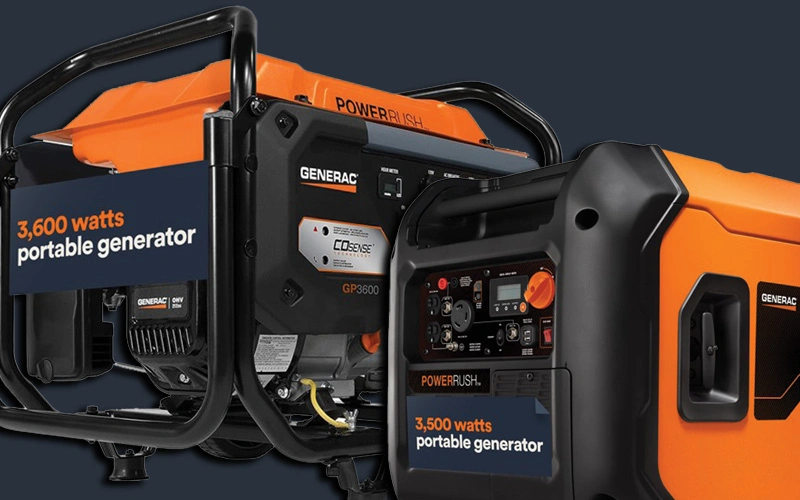
Continuous draw, listed as running watts, is what a device uses once it settles into normal operation. Startup surge, also listed as starting watts, is the brief spike that occurs when an electric motor or compressor first engages. Comparing starting watts vs running watts for each item on your list is the fastest way to catch a sizing mistake before it happens.
The spike lasts only a second or two, but your backup unit has to supply it or the appliance stalls and the breaker trips. Anything with a motor behaves this way: refrigerators, well pumps, air conditioners, air compressors. If you’re sizing for a refrigerator specifically, our guide on what size generator to run a refrigerator breaks down the numbers by fridge type.
Devices without motors, like a toaster or a space heater, draw the same amount of power at all times. Their two columns match in the table above.
In practice, only one appliance surges at any given moment, so you add all the continuous figures but count only the largest spike.
Expert Insight from Bobby Mulholland
“The data plate tells you what the unit drew the day it left the factory. A ten-year-old refrigerator with a tired start capacitor can pull thirty percent above that figure, and a well pump in a deep casing pulls more than the same pump in a shallow one.”
Bobby recommends measuring with a clamp meter on anything older than 8 years before finalizing a size. His other rule: never assume the furnace and the well pump will cycle at different times, because on a cold night they will not.
How Many Watts to Power a House With a Generator
For essential circuits only, meaning refrigerator, furnace fan, sump pump, lights, and outlets, most homes need 3,500 to 10,000 watts depending on how many of those circuits are included. That range covers the loads that prevent frozen pipes, flooded basements, and spoiled food.
For a whole home with central air conditioning, an electric range, and an electric water heater, plan on 17,000 to 22,000 watts. Homes with electric heat or two HVAC zones can push past 24,000. For a closer look at what whole house generator coverage actually includes, see our full breakdown.
Square footage matters less than what actually runs on electricity, so add your own figures from the table rather than estimating from house size. A 4,000 square foot home with gas heat, a gas range, and a gas water heater may need less than a 1,800 square foot all-electric home.
Load Calculation Scenarios and Motor Loads
Here are three examples showing how the math works in practice. Think of this as a generator load chart in miniature: swap in your own appliances and the same math applies.
Example 1, Essentials Only:
Refrigerator (700 / 1,200), furnace fan 1/3 HP (700 / 1,400), lights (300), sump pump 1/3 HP (800 / 1,300).
Total: 2,500 continuous plus 1,400 surge equals a minimum of 3,900. This sits near the low end of the essentials range above; add a well pump or garage door opener and the total climbs toward the higher end.
Example 2, Comfortable Outage:
Refrigerator (700 / 1,200), microwave (1,500), clothes washer (1,200 / 2,300), window air conditioner (1,200 / 1,800), lights (300).
Total: 4,900 continuous plus 2,300 surge equals a minimum of 7,200.
Example 3, Whole Home:
Central air conditioning (3,500 / 5,000), electric water heater (4,000), refrigerator (700 / 1,200), furnace fan (875 / 2,350), well pump (1,000 / 2,100), lights and outlets (800), electric range (2,100).
Total: 12,975 continuous plus 5,000 surge equals a minimum of 17,975.
Motorized appliances draw two to three times their steady current when they engage. The formula stays the same in every case:
Total Requirement = (Sum of All Continuous Loads) + (Single Highest Surge)
Advice from Barret Abramow
“People build the appliance list carefully, then forget the loads that turn themselves on. The furnace fan and the well pump both decide when they run, not you. Size for the worst simultaneous moment, not the average one.”
Barret adds a second rule: keep steady demand at roughly 80 percent of rated output. A unit run at full capacity for eight hours overheats, burns more fuel, and ages faster than one carrying a comfortable load.
Generator Sizes and What Each One Covers
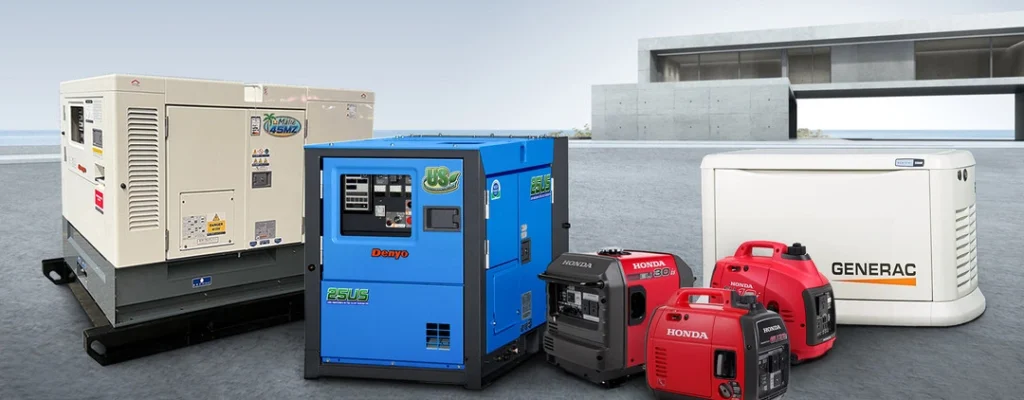
Once you know your total, match it to a size class. Each range serves a different purpose. For a full breakdown by wattage, see our generator size chart.
Small, 1,000 to 3,000 starting watts. Camping, tailgating, and a handful of home circuits. Enough for lights, phone charging, a modem, and a small refrigerator, though not all at once.
Medium, 3,000 to 8,000 starting watts. The most common home backup range. Covers a refrigerator, sump pump, furnace fan, lights, and a window air conditioner. A 6,000-watt inverter generator sits in the middle of this class and suits most essential-circuit setups.
Large, above 8,000 starting watts. Whole-home coverage, extended outages, and job sites. Handles central air conditioning, electric water heaters, and 240V appliances simultaneously.
Inverter, Open Frame, and Standby Units
Inverter models produce clean sine wave output that is safe for laptops, televisions, and appliance control boards. They adjust engine speed to match demand, so they run quieter and burn less fuel at partial load.
Open frame portable models cost less per watt and work well for tools and job sites. They are louder and less suited to sensitive electronics.
Standby units install permanently, connect to natural gas or propane, and start automatically when utility service drops. They are the practical choice above 12,000 watts.
How to Choose the Right Size
Follow these steps to find the right model:
- List every item you need during an outage.
- Find each one’s continuous figure in the table above.
- Add the single highest surge value.
- Bobby and Barret recommend building in 20 percent of that total as headroom.
- Compare the final number to the unit’s rated output.
You can also check our full guide on choosing a generator for your home, which includes simple sizing tips and examples.
Example Calculation
A total of 4,000 continuous plus 2,000 surge equals 6,000. Add the recommended 20 percent headroom, and you land at 7,200, so a 7,500-watt unit fits.
Oversizing wastes fuel and causes wet stacking in diesel units. Undersizing trip breakers shortens the life of every motor connected to them.
Honda vs Generac Wattage Charts
Both manufacturers publish detailed reference tables, and they differ in useful ways. A Honda generator wattage chart segments its data by application: home, recreational, construction, and farm equipment. Its charts also flag which appliances need 240V service, which matters when you are deciding between a portable and a standby unit.
Generac organizes its figures around whole-home coverage and standby sizing, which suits homeowners planning permanent installation rather than portable backup.
Honda units run quieter and suit smaller homes and recreational use. Generac models deliver higher sustained output built for long outages.
Barret Abramow’s Expert Tip
“Brand matters far less than measuring your own loads. A correctly sized budget unit outperforms an oversized premium one every time.”
If you do go with a Generac unit, fuel cost is worth checking in advance. See the cost to run a Generac generator for real data on fuel use and efficiency.
Interactive Sizing Calculator
Generator Size Chart
| Item | Running W | Starting W | Qty |
|---|
Tip: Enter quantities to include an item. You can edit names and watts or add custom lines.
How the calculator works
- We add all running watts and take the single highest starting watts.
- Base requirement = running total + highest starting.
- Safety margin adds extra headroom for real conditions.
- Use the result to compare portable and standby generators.
Values are typical references. Always check the nameplate on each appliance and follow local codes.
Downloadable Generator Wattage Chart
Grounded Electric offers a printable PDF wattage chart for generators and a generator usage chart you can keep on hand during an outage. It carries the same 61 entries as the tables above and is formatted for a clipboard or a utility room wall.
The reference follows Honda Power Equipment and Generac published specifications. Print it once and check items off as you build your load list.
Expert Tips for Safe Use
- Plan your loads. Feed critical circuits first, then add comfort items.
- Use a transfer switch. It prevents backfeed onto utility lines and protects line crews. Our guide on how to hook up a generator to your house walks through the wiring process in detail.
- Stay under 80 percent of rated output during sustained operation.
- Measure older appliances with a clamp meter rather than trusting the label.
- Maintain regularly. Check oil, fuel, and filters on schedule. Our generator fuel consumption calculator helps estimate how much fuel your setup will use during an extended outage.
- Never operate indoors or in a garage, even with the door open. Carbon monoxide from generators is a real risk every storm season; see our breakdown of carbon monoxide deaths linked to generators for what to watch for.
Need Professional Help?
If you are unsure about sizing or wiring, Grounded Electric can help. If you’re budgeting ahead of time, our standby generator installation cost guide breaks down what to expect by system size. Their licensed electricians measure actual loads, size the equipment, and install it in accordance with local code. Every installation is designed for long-term safety.
Bobby and Barret personally review every generator installation against local code before sign-off, following the same safety standards on every project regardless of size.
